第一章-导论
What is the Internet
-
设备(devices)
准确的说,所有的设备都被称作主机(host)或者端系统(end system)
-
分组交换机(Packet switches)
转发“分组”(packet, chunks of data),常见的有路由器(router)和交换机(switch)
-
通信链路(communication link)
端系统通过通信链路和分组交换剂连接到一起
What is Protocol
-
协议(Protocol)
协议定义了在两个或多个通信实体之间交换的报文(message)的格式(format)和顺序(order),以及报文发送和/或接收一条报文或其他事件所采取的动作(actions)
网络边缘(Network Edge)
-
接入网(Access Network)
将端系统物理连接到其边缘路由器(Edge Rounter)
three ways:
- 家庭接入
- 企业接入
- 广域无线接入
关注的焦点:
- 传输速率(transmission rate, bits per sec)
- 在多大程度上与其他用户共享网络
- 电缆接入(cable-based access)
采用频率划分多路复用(频分复用,frequency division multiplexing),不同的信道在不同的频率上传输
asymmetric:下行速度比上行速度快
-
数字用户线(Digital subscriber line, DSL)
从提供本地电话接入的本地电话公司出获得因特网接入
asymmetric
-
无线网络(wireless access networks)
wireless local area networks(wifi); wide-area cellular access networks(3g, 4g)
-
企业网络(enterprise networks)
Network Core
-
分组交换(packet switching)
端系统/主机将应用层的报文(message)分成数据包(称为分组,packet),在源(source)和目的地(destination)之间,每个分组都通过通信链路和分组交换机传送。
-
转发(forwarding)和路由(routing)
转发的 local action:move arriving packets from router’s input link to appropriate roter output link
路由的 global action:determine source-destination paths taken by packets; with certain routing algorithm
-
电路交换(circuit switching)
两种方式为:频分复用(Frequency division multiplexing, FDM)和时分复用(Time division multiplexing, TDM)
circuit switching vs packet switching,例子:
-
假设有 1gb/s 的带宽,每个用户在 ‘active’ 时需要 100mb/s,约定 active 10% of time
- 对于 circuit switching,因为路线是独享的,所以只有 \(\frac{1gb/s}{100mb/s}=10\) 个用户
-
但对于 packet switching,可以证明当用户人数 = 35 时,同时有超过 10 个人 ‘active’ 的概率小于 0.0004(证明如下)
\[ 二项式定理 \] -
电路交换和分组交换的优缺点:
分组交换对于”爆发性“的数据有优势(大部分时间空闲),resource sharing; simpler,缺点在于可能会造成阻塞(congestion)
Performance: loss, delay, throughput
Packet delay:
\(d_{nodal}=d_{proc}+d_{queue}+d_{trans}+d_{prop}\)
d_proc: nodal(节点) processing (check bit errors, determine output link, etc. typically < microsecs),处理延迟,采用硬件处理,速度快
d_queue: queueing delay (time waiting at output link for transmission, depends on congestion level),排队延迟
d_trans: transmission delay, 传输延迟
\(d_{trans}=\frac{L}{R},\text{L is the packet length(bits), R is the link transmission rate(bps)}\)
d_prop: propagation delay, 传播延迟
\(d_{prop}=\frac{d}{s},\text{d is the length of physical link, s is the propagation speed }\sim2\times10^8m/sec\)
那么如何表征排队时延呢?或许可以从三个方面来考虑:流量到达队列的速率、链路的传输速率和到达流量的性质。即流量是周期性到达还是突发性到达,如果用 a 表示分组到达队列的平均速率( a 的单位是分组/秒,即 pkt/s)前面说过 R 表示的是传输速率,所以能够从队列中推出比特的速率(以 bps 即 b/s 为单位)。假设所有的分组都是由 L 比特组成的,那么比特到达队列的平均速率是 La bps。那么比率 La/R 被称为流量强度(traffic intensity)
Packet loss:
再讲丢包
- 队列(又称缓冲区)缓冲区中的前一个链路的容量有限
- 到达满队列的数据包除了被丢掉没得选
- 丢失的数据包可以由前一个节点、源端系统重新传输,也可以根本不重新传输
Throughput(吞吐率):
throughput: rate(bits/time unit) at which bits are being sent from sender to receiver;
- 描述的是整个【从发送方到接收方】的传输速率 (bits/time unit)
- 分为瞬时(instantaneous)和平均(average)
- 瓶颈链路(bottleneck link):限制端吞吐量的端路径上的链接,说人话就是路径上带宽最小的那段
Protocol layers, service models
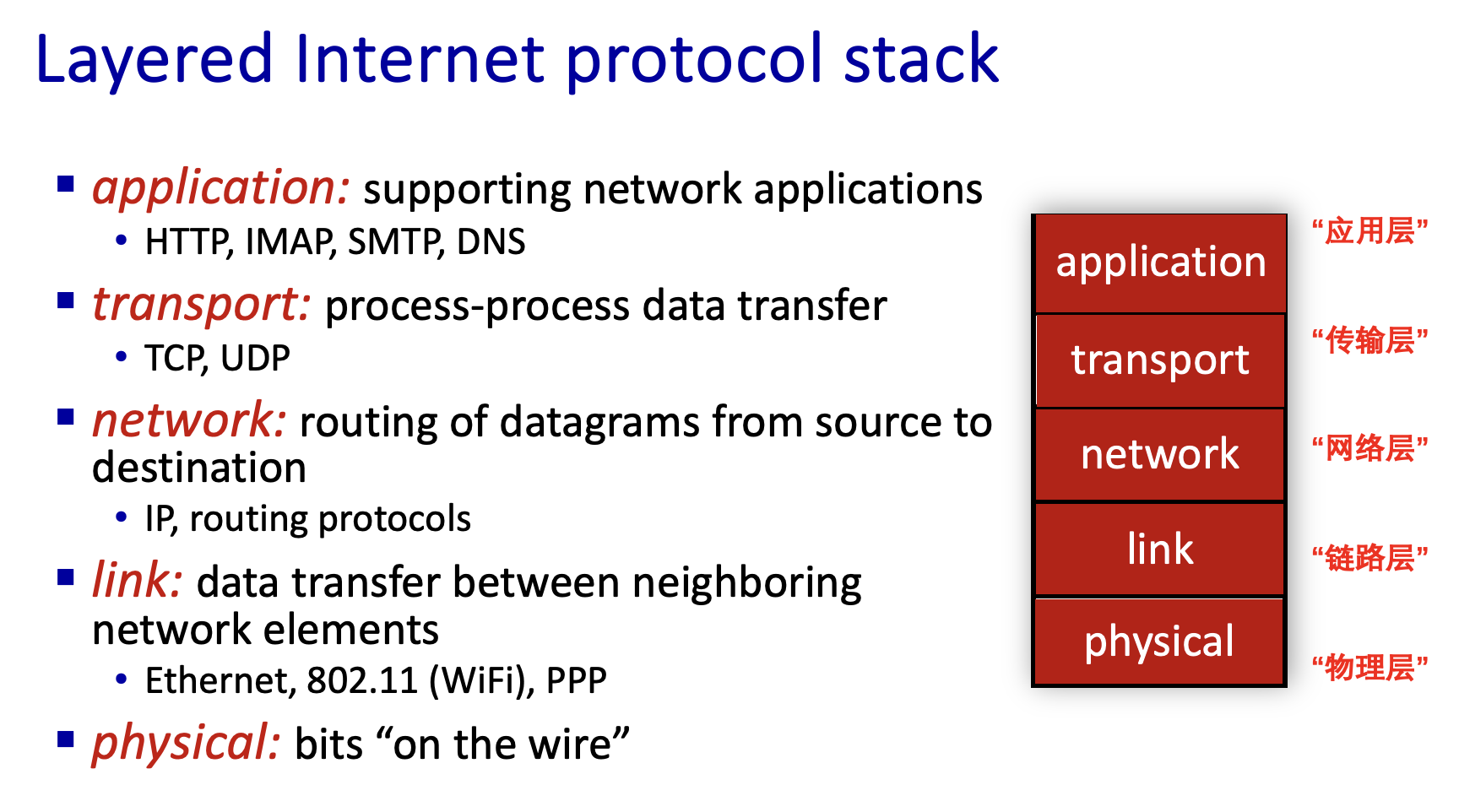
五层:
应用层(message,报文)
传输层(segment,报文段)
网络层(datagram,数据报)
链路层(frame,帧)
物理层